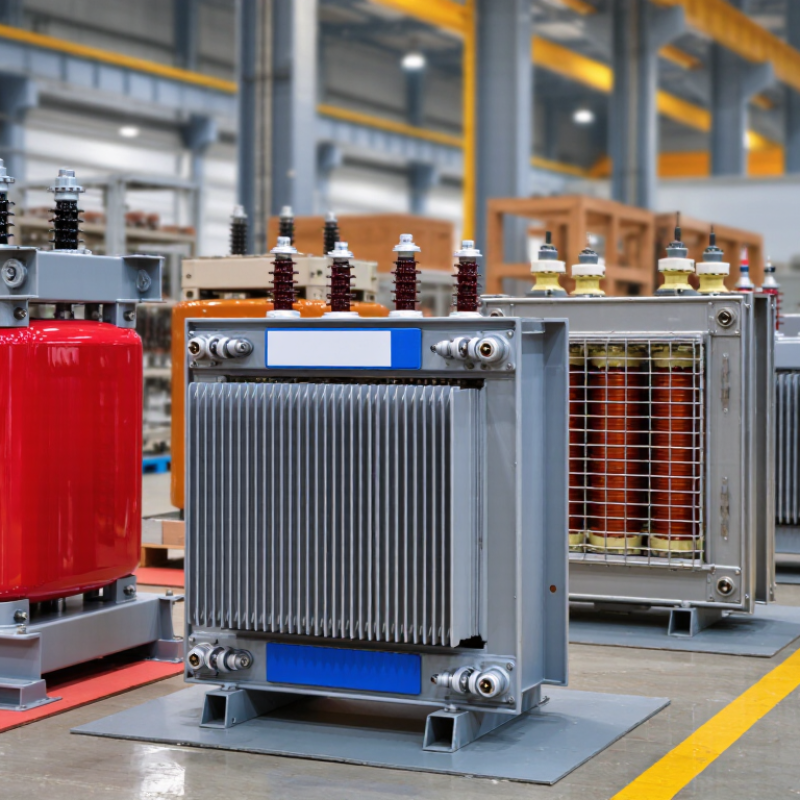
Global power demand is entering a more infrastructure-intensive phase. The International Energy Agency’s Electricity 2024 report projects average global electricity-demand growth of about 4% annually through 2026. This expansion supports new substations, renewable-energy projects, data centers, and industrial facilities. Each application creates different transformer requirements. A dry type transformer can reduce liquid-leak risks, simplify indoor installation, and support fire-conscious building designs. However, it is not automatically the best choice for every site.
This guide examines the leading dry-type transformer types considered by global buyers in 2026, including cast-resin, vacuum pressure impregnated, open-wound, and amorphous-core designs. Grand View Research and MarketsandMarkets report continued market growth, driven by grid modernization, commercial construction, and renewable integration. Their forecasts differ, which matters. A market forecast is not a purchase specification. Buyers should verify temperature rise, insulation class, altitude correction, enclosure rating, sound level, losses, and short-circuit performance.
International acceptance also depends on documented compliance. IEC 60076-11 addresses dry-type power transformers, while IEEE C57.12.01 provides widely used American requirements. In a factory, a 2,000 kVA cast-resin unit may suit a compact indoor substation, while a ventilated VPI transformer may offer practical access for maintenance. Site conditions decide.
No single ranking fits every project. Experienced procurement teams compare lifecycle cost, lead time, testing records, service support, and local grid rules. This article therefore treats “top” as application-specific, not merely the highest-selling option. Some assumptions will need review as technology, regulations, and supply chains continue changing.
2026 Top dry type transformer Types for Global Buyers
Dry-type transformers transfer electrical energy through electromagnetic induction without liquid insulation. The core guides magnetic flux, while copper or aluminum windings carry current through changing fields. Air is the insulator. Heat changes everything.
During operation, voltage enters the primary winding and creates a magnetic field in the laminated steel core. This field induces a new voltage in the secondary winding. The turns ratio controls voltage conversion. Insulation around each winding limits electrical stress and prevents unwanted contact.
Unlike oil-filled equipment, dry-type units rely on ventilation and solid insulation to remove heat. Open or ventilated designs suit clean indoor rooms, while resin-encapsulated designs offer stronger protection against moisture and dust. Buyers should check rated power, frequency, temperature rise, altitude, noise, enclosure rating, and cooling method. Site conditions often matter more than a catalog image. In field inspections, blocked air passages and loose connections repeatedly cause avoidable temperature problems. Still, no design is perfect; resin protection can complicate repairs, and ventilated units may need cleaner surroundings.
Tips: Keep clear airflow around the enclosure. Measure room temperature during peak load. Verify local installation requirements. Ask for tested efficiency and temperature-rise data. Surface dust looks harmless, but it can reduce cooling performance.
In 2026, global buyers are comparing dry-type transformer types by safety, climate, efficiency, and installation space. Cast-resin transformers remain popular for hospitals, offices, tunnels, and industrial buildings. Their sealed windings resist moisture, dust, and chemical exposure better than many open designs. They also reduce fire risk because they contain no liquid insulation.
Vacuum pressure impregnated transformers suit factories, renewable-energy facilities, and commercial substations requiring strong mechanical performance. Their varnish-treated windings can provide dependable insulation when ventilation is properly designed. Air-natural cooling, or AN, works well for normal loads and quieter indoor installations. Air-forced cooling, or AF, adds fans for temporary overloads, but fan failure deserves careful planning. Space changes everything. A compact enclosure may restrict airflow and increase operating temperature.
Global buyers should also examine amorphous-core dry transformers when lower no-load losses matter over long operating hours. These models can support energy-saving targets, although purchase cost, available service skills, and replacement parts may affect the real return. I have seen projects focus heavily on efficiency while overlooking altitude, salt air, or sudden load changes. That approach needs reflection. A transformer rated for a mild indoor site may struggle in a humid coastal plant.
Before ordering, compare applicable IEC or IEEE requirements, temperature-rise limits, sound levels, partial-discharge data, and short-circuit strength. Request routine and type-test records from qualified manufacturers. Confirm cable entry, enclosure protection, maintenance access, and spare-fan arrangements. Noise still matters. A technically sound transformer can create complaints if installed beside occupied rooms.
| Transformer Type | Typical Construction | Common Capacity Range | Typical Voltage Range | Cooling Method | Key Advantages | Typical Applications | Important Buyer Considerations | Common Standards |
|---|---|---|---|---|---|---|---|---|
| VPI Transformer (Vacuum Pressure Impregnated) | Coils are insulated with resin and treated under vacuum and pressure. The windings remain relatively open compared with fully cast designs. | 100 kVA–20 MVA | Low voltage and medium voltage; commonly up to 36 kV system class, depending on design. | AN or AF (air natural or forced air) | Good thermal performance Repairable winding structure Suitable for large ratings Lower mass than cast resin | Commercial buildings, industrial plants, renewable-energy facilities, data centers, transportation systems and indoor substations. | Check moisture protection, partial-discharge performance, altitude derating, fire requirements and the availability of qualified maintenance personnel. | IEC 60076-11, IEEE C57.12.01, IEC 60076 series |
| Cast Resin Transformer | Medium-voltage windings are encapsulated in solid epoxy resin, providing a sealed and mechanically stable insulation system. | 50 kVA–20 MVA | Low voltage and medium voltage; commonly up to 36 kV system class, with higher values available for specific designs. | AN or AF | Strong moisture resistance Low fire risk Low maintenance Good short-circuit strength | Hospitals, airports, underground facilities, high-rise buildings, tunnels, marine installations and locations with strict fire-safety requirements. | Evaluate resin quality, thermal cycling capability, partial-discharge level, noise, enclosure rating and repair or replacement strategy after severe damage. | IEC 60076-11, IEC 60076-16, IEEE C57.12.01 |
| Open-Wound Transformer | Windings are vacuum- or dip-impregnated and then cured, but they are not fully encapsulated in epoxy resin. | 15 kVA–5 MVA | Low voltage and medium voltage; commonly up to 15 kV or 24 kV class. | AN or AF | Cost-effective Good heat dissipation Lightweight Simple inspection access | Indoor commercial installations, machinery systems, control power, process equipment and general industrial distribution. | It requires a clean and reasonably dry installation environment. Confirm the required enclosure, ventilation, dust protection and condensation control. | IEC 60076-11, IEEE C57.12.01 |
| Encapsulated Transformer | Windings or the complete active part are enclosed by resin or another solid insulating compound for improved environmental protection. | 25 kVA–5 MVA | Low voltage and medium voltage; commonly up to 24 kV system class. | AN or AF | Enhanced dust protection Improved humidity resistance Reduced maintenance Suitable for harsh interiors | Food-processing areas, wastewater plants, coastal buildings, industrial workshops and installations with dust or occasional moisture exposure. | Confirm the actual encapsulation level, heat dissipation path, enclosure IP rating and compatibility with chemical or salt-laden atmospheres. | IEC 60076-11, IEC 60529 for enclosure protection where applicable |
| Air-Core Transformer | Primary and secondary windings use air as the magnetic medium instead of a ferromagnetic core. | Typically below 1 MVA; specialty ratings may be higher. | Low voltage to high-frequency or special-purpose systems; voltage depends strongly on the application. | Air natural or forced air | No core saturation Low audible magnetizing noise Suitable for high frequency No core loss from hysteresis | Power-electronics systems, high-frequency converters, induction heating, testing equipment and specialty isolation applications. | It generally needs more physical space and may have higher leakage reactance. Confirm electromagnetic-field limits, insulation coordination and thermal design. | Application-specific requirements; IEC 60076 principles may apply where relevant |
| Three-Phase Dry-Type Transformer | A three-phase magnetic core with three-phase primary and secondary windings; it may use VPI, open-wound or cast-resin insulation. | 50 kVA–20 MVA | Low voltage and medium voltage; commonly up to 36 kV system class. | AN or AF | Efficient distribution Compact footprint Balanced three-phase load Lower installation complexity | Factories, commercial complexes, utility substations, solar farms, wind-power systems and large building distribution networks. | Specify vector group, impedance, neutral arrangement, harmonic loading, inrush current, tap range and short-circuit withstand requirements. | IEC 60076 series, IEC 60076-11, IEEE C57.12.01 |
| Single-Phase Dry-Type Transformer | A single-phase core-and-coil assembly used for isolation, voltage conversion or localized distribution. | 0.05 kVA–1 MVA | Extra-low voltage, low voltage and selected medium-voltage applications. | AN or AF | Flexible installation Easy replacement Suitable for isolated loads Simple system expansion | Lighting circuits, control panels, residential and small commercial systems, medical equipment and machine tools. | Check phase loading, grounding method, enclosure dimensions, sound level, control-circuit compatibility and the need for a shield between windings. | IEC 61558 for applicable small transformers, IEC 60076 series for power transformers |
| Dry-Type Isolation Transformer | Primary and secondary windings are electrically separated to provide galvanic isolation and voltage transformation. | 0.1 kVA–2.5 MVA | Extra-low voltage to medium voltage, depending on the system design. | AN or AF | Galvanic isolation Noise reduction options Improved fault separation Flexible voltage ratios | Medical locations, laboratories, automation systems, data-processing equipment, control systems and sensitive electronic loads. | Determine whether an electrostatic shield is required. Also verify leakage current, grounding, shield termination, regulation and non-linear load capability. | IEC 61558 for applicable equipment, IEC 60076-11, IEEE C57.12.01 |
| Dry-Type Autotransformer | Primary and secondary circuits share part of the same winding, reducing material use and physical size. | 25 kVA–10 MVA | Low voltage and medium voltage applications with relatively close input and output voltages. | AN or AF | High efficiency Compact design Lower cost for close ratios Good voltage regulation | Motor starting, feeder voltage adjustment, industrial distribution and voltage conversion where galvanic isolation is not required. | There is no complete electrical isolation between input and output. Confirm fault-current levels, grounding, insulation coordination and permissible voltage ratio. | IEC 60076 series, IEEE C57.12.01 |
| Harmonic-Mitigation Dry-Type Transformer | Designed with suitable winding configuration, phase shifting or impedance characteristics to reduce triplen or other harmonic effects. | 75 kVA–5 MVA | Low voltage and medium voltage distribution systems. | AN or AF | Supports nonlinear loads Controls additional heating Improves power quality May reduce neutral stress | Data centers, variable-speed drives, UPS systems, commercial buildings, LED lighting networks and industrial automation. | Size by harmonic spectrum rather than kVA alone. Review K-factor or equivalent thermal design, neutral current, impedance and expected load growth. | IEEE C57.110, IEC 60076-11, applicable power-quality requirements |
| Rectifier or Converter Duty Dry-Type Transformer | Reinforced insulation and thermal design for rectifier, inverter or power-electronic converter loads, often with special winding arrangements. | 100 kVA–10 MVA | Low voltage and medium voltage; project-specific primary and secondary voltages. | AN or AF | Handles cyclic loading Designed for harmonics Suitable for phase-shift systems High short-circuit capability options | Electric-vehicle charging, industrial drives, electrolysis, traction systems, battery storage and renewable-energy converters. | Provide the converter pulse number, duty cycle, harmonic spectrum, DC bias risk, inrush profile, cooling conditions and overload schedule during specification. | IEC 60076 series, IEC 61378 where applicable, IEEE C57.12.01 |

Dry type transformers differ sharply in heat control, insulation strength, noise, and maintenance. Cast resin units seal windings in epoxy, reducing moisture exposure and fire risk in hospitals, offices, and tunnels. VPI transformers use vacuum-pressure insulation and often offer easier inspection. Open-wound designs can be cost-effective, but dusty or humid rooms demand stronger enclosure protection.
Efficiency is not only a nameplate number. The U.S. Department of Energy’s 2024 transformer rulemaking documents identify no-load and load losses as major lifetime cost drivers. The EU Ecodesign framework also pushes lower transformer losses across operating conditions. Larger cores may reduce losses, but they increase weight and embodied material. That trade-off is easy to underestimate. Acoustic performance matters too. A lightly loaded unit can still produce an annoying low-frequency hum.
Tips: Compare total ownership cost, not purchase price. Request no-load loss, load loss, temperature-rise, short-circuit, and sound data. Check IEC 60076-11 test evidence. For coastal sites, specify suitable enclosures and humidity controls. For solar or battery projects, review frequent load changes and harmonics. A standard design may work. It may also age faster than expected.
Selecting a dry type transformer starts with the installation, not the catalog. Confirm the primary and secondary voltages, frequency, load profile, and future capacity needs. A small office may suit a cast resin unit with low noise and limited maintenance. A factory with frequent motor starts needs stronger short-circuit performance and better thermal margins. Do not size only for today’s measured load.
Site conditions matter more than many buyers expect. For dusty workshops, choose suitable enclosure protection and provide clear ventilation paths. In humid coastal areas, inspect insulation performance, condensation risks, and corrosion protection. High-altitude sites may require derating because thinner air reduces cooling efficiency. Indoor units often prioritize low sound levels, while substations may need stronger mechanical protection. Quiet operation matters near hospitals and residential buildings.
Winding design also affects selection. Cast resin transformers resist moisture and mechanical stress, while impregnated designs can offer practical performance in controlled environments. Harmonic-producing equipment may require a transformer with an appropriate K-factor or equivalent thermal design. Verify applicable IEC or IEEE requirements, temperature rise, fire behavior, routine tests, and installation clearances. Ask for temperature-rise data, impedance values, loss figures, and test reports.
A perfect selection rarely exists. An oversized transformer can waste energy and space. An undersized one may run hot for years. Field experience shows that incomplete site data causes many avoidable errors. Recheck cable lengths, ventilation, ambient temperature, and actual starting currents before approving the final specification.
Global buyers should match transformer construction with local standards and site conditions. Cast-resin units suit humid rooms and higher fire-safety expectations. VPI transformers can offer efficient cooling in clean, controlled environments. Air-core designs may fit specialized applications, but they demand careful electromagnetic planning.
Check IEC 60076-11, IEEE C57.12.01, and the destination country’s grid requirements. Standards may differ in temperature rise, insulation levels, testing, and enclosure protection. Confirm the rated voltage, frequency, short-circuit impedance, and tap range before comparing quotations. A familiar rating is not always compatible.
Installation details often decide long-term performance. Measure door widths, lifting paths, floor loading, ventilation, and maintenance clearance. At high altitude, reduced air density can affect cooling. Dusty sites may need a stronger enclosure, while coastal locations require corrosion-resistant treatment. Keep the transformer away from heat sources and water leaks.
Do not choose by price alone.
A lower-cost unit may require larger ventilation systems or more frequent cleaning. Ask for routine test reports, temperature-rise data, acoustic levels, loss calculations, and service procedures.
In practical assessments, buyers sometimes overlook cable bending space. That mistake can delay commissioning and increase installation costs. Some specifications also remain vague, especially for partial discharge limits. Request measurable acceptance criteria before signing.
DENTSPLY Maillefer - USA
5100 E. Skelly Drive, Suite 300
Tulsa, Oklahoma 74135
DENTSPLY Maillefer - Canada
161 Vinyl Court
Woodbridge, ON L4L 4A3
Toll-free in the U.S.:
1-800-924-7393
Toll-free in Canada:
1-800-263-1437
Toll-free in the U.S.:
1-800-924-7389
Toll-free in Canada:
1-888-336-8775