
Sourcing Dental Surgery Lighting China can reduce procurement costs, but price alone should never guide the decision. Dental lighting affects visibility, shade matching, clinician comfort, and patient safety during long procedures. A reliable supplier should explain illuminance, color temperature, color rendering, shadow control, and arm movement clearly. Ask for test data, not attractive promises. Request product samples or detailed videos showing the light above a dental chair. Small details matter. A loose joint or stiff handle becomes frustrating every day.
This guide presents seven practical tips for evaluating Chinese manufacturers and trading companies. It covers factory capability, optical performance, customization, quality control, documentation, communication, and after-sales support. Suppliers should provide traceable specifications and relevant certifications for your target market. Confirm whether the certificate applies to the exact model, not merely a similar product. That mistake is easy to make. It can create costly delays.
Experienced buyers also inspect packaging, replacement parts, warranty terms, and production consistency. A polished sample may not represent every shipment. Ask how the supplier controls LED quality and final assembly. Request inspection photos before loading. Independent inspection can add time, yet it may prevent larger problems. No sourcing process is perfect. Even experienced teams can overlook a small connector, an unclear voltage requirement, or a missing user manual. Careful questions expose those gaps early. With a structured approach, Dental Surgery Lighting China becomes a manageable procurement project rather than a risky search based on catalog images.
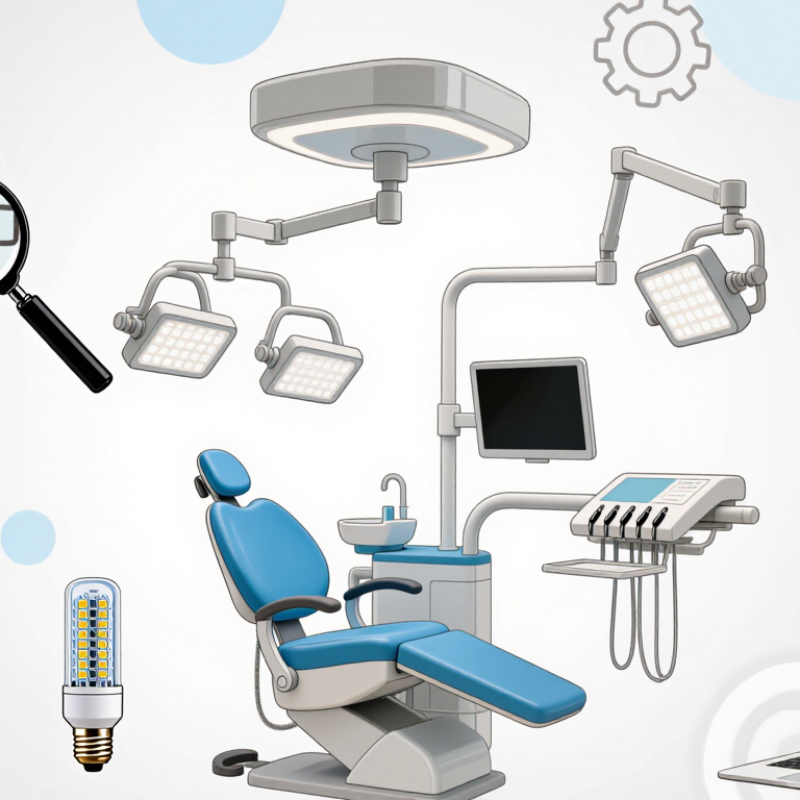
Define your dental surgery lighting requirements before contacting Chinese suppliers. The WHO Global Oral Health Status Report 2022 estimates that oral diseases affect nearly 3.5 billion people worldwide. This scale demands reliable clinical equipment, not simply bright lamps. Record the procedure type, treatment area, ceiling height, chair position, and clinician’s working distance. For a dental operatory, consider around 1,000 lux for general room lighting, with higher field illumination for procedures. IEC 60601-2-41 should guide requirements for surgical and examination luminaires. Ask for measured photometric data, not catalogue promises.
Colour quality matters. Specify CRI above 90, with strong red rendering for tissue observation and shade assessment. A neutral colour temperature around 4,000–5,000 K often supports visual comfort, though surgeon preference varies. Check shadow control using the manufacturer’s test method. Confirm the light head can move smoothly without drifting. Verify sterilizable handles, sealed surfaces, low heat, emergency operation, and compatibility with local voltage standards. IEA reports that lighting represents about 15% of global electricity consumption, so efficient LEDs deserve attention. Still, efficiency should not replace optical performance. I would request samples, installation videos, IEC test reports, EMC documents, warranty terms, and replacement-part lists from each Chinese factory. My checklist is not perfect. Real chairside testing may expose glare, awkward reach, or distracting reflections that specifications miss.
Tip 1 Check the manufacturer’s real production capability.
A qualified dental lighting supplier should provide a factory address, business details, product specifications, and recent quality records. Ask to see the assembly line, optical testing area, and final inspection process. During a practical factory audit, look for clean workstations, labeled components, and traceable serial numbers. A polished showroom is not enough.
Tip 2 Review technical evidence, not attractive promises.
Request test reports for illumination, color rendering, shadow control, heat management, and electrical safety. Verify whether documents match the exact model you may purchase. Relevant quality systems, such as ISO 13485, can support confidence, but certificates should be checked for validity and scope. Regional compliance requirements may differ, so confirm them with an independent specialist.
Tip 3 Test communication before signing anything.
Send detailed questions about light intensity adjustment, mounting options, warranty handling, replacement parts, and delivery inspection. Notice whether the supplier gives precise answers or avoids difficult points. Sample testing matters. A lamp may look excellent in a catalog but feel uncomfortable above a dental chair. This is where my own judgment can be imperfect; technical data still needs hands-on review. Ask for a sample, record observations, and compare results with your clinical requirements.
Dental surgery lighting requires more than high brightness. The WHO Global Oral Health Status Report 2022 estimates that nearly 3.5 billion people live with oral diseases. This demand makes dependable equipment essential. During supplier screening, request test reports for IEC 60601-1 and IEC 60601-2-41. The latter covers surgical and diagnostic luminaires, including illumination performance and electrical safety.
Check the certificate details carefully. ISO 13485 shows that a manufacturer operates a medical-device quality system, but it does not prove every lamp is safe. Ask whether the certificate covers the actual factory and product category. For European distribution, verify the technical file, declaration of conformity, and applicable MDR evidence. For the United States, FDA establishment registration is not the same as product approval. That distinction matters.
Inspect more than documents. Request photometric data, color-rendering results, shadow tests, heat measurements, and durability records. A reputable supplier should provide serial-number traceability and calibration evidence. Visit the production line if possible. Look at wiring, sealing, and handle sterilization procedures. Small details reveal process discipline. Some buyers accept copied certificates too quickly. I have seen specifications checked carefully, while factory controls received little attention. That remains a weak point. Confirm after-sales response times, spare-part availability, and corrective-action procedures before signing.
Recommended verification priorities for checking product standards, certifications, and supplier credentials before purchasing dental surgery lights.
How to use this chart: The 100-point weighting is an editorial sourcing framework, not a company or brand ranking. Prioritize electrical safety, surgical-luminaire compliance, photobiological safety, quality-system evidence, risk management, export documentation, and supplier after-sales capability. Relevant references may include IEC 60601-1, IEC 60601-2-41, IEC 62471, ISO 13485, ISO 14971, and applicable market regulations such as the EU Medical Device Regulation.
7 Tips for Sourcing Dental Surgery Lighting China
Compare lighting performance before comparing prices. Tip 1: Request photometric reports from an accredited laboratory. Check illuminance, uniformity, beam diameter, shadow control, glare, and heat output. Tip 2: Verify color quality using CRI and R9 values, not CRI alone. IES TM-30 provides a more detailed method for evaluating color fidelity. Tip 3: Ask whether the light has been tested against ISO 9680 and IEC 60601-2-41 requirements. Certificates should match the exact model and production version.
Tip 4: Compare real operating features. Sensor controls, adjustable color temperature, sealed handles, dimming, and emergency backup can reduce workflow interruptions. Tip 5: Inspect the factory’s quality process. Review incoming LED checks, final photometry, electrical safety testing, and batch traceability. A factory video is not evidence. Request records. Tip 6: Calculate total landed cost, including tooling, packaging, shipping, import charges, installation, spare parts, and warranty returns. The U.S. Department of Energy reports that LED products use at least 75% less energy and can last up to 25 times longer than incandescent lighting. However, clinical fixtures have different duty cycles and maintenance needs.
Tip 7: Compare five-year ownership costs, not only the quotation. Include driver replacement, calibration, downtime, and technician travel. A low offer may hide weak documentation or expensive repairs. The first spreadsheet is rarely complete. Recheck assumptions with a working dentist and an electrical engineer. A small mistake in glare or shadow performance can become a daily clinical problem.
7 Tips for Sourcing Dental Surgery Lighting China
Order samples before discussing large quantities. A sample reveals beam stability, handle movement, surface finish, and actual brightness. In my experience, product photos often hide uneven illumination. Test the light above a dental chair for several hours. Check whether the lamp head drifts after repeated positioning. Measure color rendering, illumination, and shadow control with suitable instruments. Do not rely only on a supplier’s written figures. Ask for test reports, operating instructions, and electrical safety documentation. Small details matter.
Confirm the warranty in writing. It should state the coverage period, included components, labor responsibilities, and replacement process. Ask what happens when a control panel fails during installation. Request photos of previous packaging and inspect the sample carton for corner protection. One careless assumption can become an expensive delay. My early mistake was accepting a general warranty statement. It sounded reassuring, but it lacked response times and spare-part terms. That was not enough. Ask for a clear service contact and realistic repair timelines.
Shipping terms need equal attention. Confirm the delivery term, port or airport, packing dimensions, gross weight, and insurance responsibility. Request a pre-shipment inspection, especially for multiple lights. Check whether each unit includes mounting hardware, cables, and installation accessories. A missing bracket can stop an entire operating room project. Review the commercial invoice and packing list before dispatch. Also confirm how the supplier handles visible damage on arrival. Keep written records of sample approval, quality requirements, warranty promises, and shipping conditions. Details protect both sides.
| Tip | Data Dimension | Recommended Benchmark | Sample Verification Method | Acceptance Criteria | Records to Request |
|---|---|---|---|---|---|
| 1 | Illumination performance | 8,000–50,000 lux adjustable output, with stable illumination at the stated working distance. | Measure illuminance with a calibrated lux meter at the central light field and at the specified operating distance, commonly around 700 mm. | Measured values should remain within the supplier's declared tolerance at minimum, medium, and maximum settings. | Photometric test report, product specification sheet, and calibration details. |
| 2 | Color quality and temperature | Color rendering index CRI (Ra) ≥ 90; color temperature commonly adjustable between approximately 4,000–5,000 K. | Check white, red, and tissue-colored samples under each color-temperature setting. Confirm that controls do not produce visible flicker. | CRI and color-temperature results must match the declared specification, with no distracting color shift or noticeable flicker during operation. | CRI report, color-temperature data, LED specification, and operating video if available. |
| 3 | Light field and shadow control | Uniform light field with a clearly defined treatment area and reduced shadowing when hands or instruments enter the beam. | Test the light at the working distance using a standardized target. Place opaque objects between the light head and target to evaluate shadow recovery. | No excessive dark spots, unstable beam movement, or abrupt loss of illumination during normal positioning. | Beam-pattern images, shadow-test results, adjustment range, and installation instructions. |
| 4 | Electrical and safety compliance | Input voltage and frequency must match the destination market. Confirm applicable medical electrical safety requirements, including IEC 60601-1 where required. | Review the rating label, wiring diagram, protective-earth arrangement, power supply, and available conformity documentation before placing a bulk order. | Electrical ratings must match the purchase specification, and documentation must be traceable to the exact model and revision. | Declaration of conformity, test reports, rating-label image, wiring diagram, and user manual. |
| 5 | Mechanical construction and usability | Stable arm movement, smooth balancing, secure joints, easy-to-clean surfaces, and controls suitable for gloved operation. | Operate the sample repeatedly through its full movement range. Check drift, joint resistance, handle strength, surface finish, and touch or non-touch controls. | The light head must remain in position without unwanted movement, and all controls must function after repeated adjustment. | Material description, movement-range drawing, load or cycle-test results, and installation video. |
| 6 | Warranty and after-sales support | Obtain a written warranty period, commonly 12–24 months for the complete unit, with separate terms for LEDs, power supplies, and mechanical parts. | Ask for a draft warranty clause covering defects, replacement parts, labor responsibility, exclusions, response time, and return procedures. | Warranty coverage must identify the start date, remedy, lead time for parts, and responsibility for transport or on-site service. | Signed warranty terms, spare-parts list, service contact, troubleshooting guide, and repair-response commitment. |
| 7 | Shipping, packaging, and landed cost | Confirm the exact Incoterm, carton dimensions, gross weight, packing method, production lead time, and destination import responsibilities. | Request a freight quotation based on the actual destination and package data. Inspect shock protection, moisture protection, wooden-case treatment, and carton markings. | Purchase documents must clearly state the Incoterm, shipping mode, estimated dispatch date, insurance responsibility, spare-parts packing, and handling requirements. | Pro forma invoice, packing list, carton drawings, freight quotation, export documents, and shipping-insurance terms. |
DENTSPLY Maillefer - USA
5100 E. Skelly Drive, Suite 300
Tulsa, Oklahoma 74135
DENTSPLY Maillefer - Canada
161 Vinyl Court
Woodbridge, ON L4L 4A3
Toll-free in the U.S.:
1-800-924-7393
Toll-free in Canada:
1-800-263-1437
Toll-free in the U.S.:
1-800-924-7389
Toll-free in Canada:
1-888-336-8775